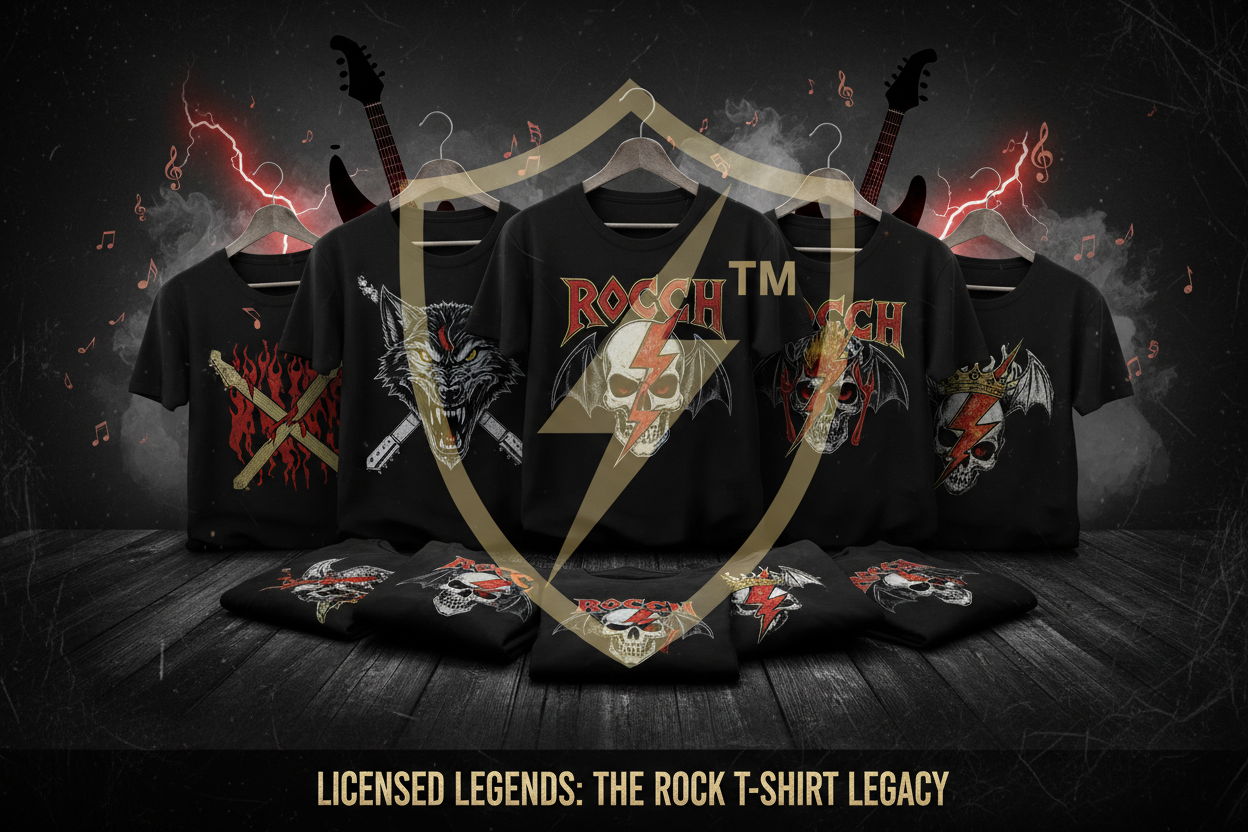
Let's be straight with you. There are bands you love, bands we love, bands that have soundtracked every sweaty gig, every late-night drive, every moment that made you feel properly alive — and you will never see them on a Moshed product. Not because we don't want to. Because we can't. And understanding why tells you everything about how the music merchandise industry actually works.
We're not a faceless corporate merch machine with a legal department the size of a small town. We're an independent brand built by people who actually go to gigs, actually own the records, actually care. But caring doesn't override trademark law. And the gap between what we'd love to make and what we're legally able to make is something we've decided to stop dancing around.
The bands you love have names, logos, and likenesses that are protected assets. Using them without a licence isn't a grey area — it's infringement, full stop.
How Band Licensing Actually Works
When a band — especially a major or legacy act — reaches a certain level, their name and visual identity become registered trademarks. This isn't just the logo on the bass drum. It covers the band name in text, specific fonts associated with the act, iconic imagery, album artwork, and in some cases even colour combinations strongly tied to their brand. These trademarks are filed in multiple territories, actively maintained, and vigorously enforced.
To produce merchandise featuring any of this, you need a licence. That licence comes either directly from the band's management, or more commonly through an officially appointed merchandising partner — large organisations that hold the rights to produce and distribute merch on the act's behalf. Think of them as the gatekeepers between the band's intellectual property and the physical products that end up on your back.
For independent brands like Moshed, getting access to those licences is not simply a case of sending an email and writing a cheque. These deals typically come with minimum order quantities in the thousands, upfront advances, royalty rates, artwork approval processes, and strict restrictions on where and how the goods can be sold. In many cases, the licensing partner won't engage with small independents at all — the economics don't work for them, and they have no incentive to make an exception.
The Difference Between Fan Art and Trademark Infringement
This is where it gets nuanced, and where a lot of people — including some brands — get it wrong. There's a persistent myth that if you change a logo enough, or make something inspired by rather than directly copying, you're in the clear. You are not. Trademark protection isn't just about exact duplication. It covers anything likely to cause confusion in the marketplace — anything that might lead a reasonable person to believe a product is officially associated with, endorsed by, or produced under licence from the rights holder.
That's a broad net. Deliberately broad. And it's designed to be, because the value of a band's trademark is tied to consumers being able to trust that official products are official. If knock-off merch muddies that water, the brand value suffers. So rights holders protect aggressively, and the law backs them up.
Fan art sold at small scale, or given away, exists in a different — and still legally murky — space. The moment you're selling clothing at commercial scale featuring a protected name or image, you're in trademark infringement territory regardless of how much love went into it.
We'd rather tell you the truth about what we can't do than quietly skirt the rules and pretend we didn't.
Why We Don't Just Risk It
Some brands do. You've seen them — the unlicensed shirts on market stalls, the dodgy print-on-demand sites, the suspiciously cheap band tees that appeared overnight. There's a whole shadow economy built on ignoring trademark law and hoping nobody important notices.
We're not interested in that. Partly because the legal exposure is real — cease and desist letters are the optimistic outcome; litigation and damages are the worst case. But mostly because it's just not how we want to operate. The artists who built these bands, the designers who created those iconic images, the people who sweated over every detail of how their act is presented to the world — they deserve to control how that work is used commercially. Cutting corners on that isn't punk. It's just theft dressed up in a band tee.
We also think it matters for the culture. When unlicensed merch floods the market, it devalues official products, cuts artists out of revenue they're owed, and contributes to an environment where intellectual property becomes a free-for-all. That's not a world that benefits musicians, designers, or fans long term.
What We Can Do — And Do Well
Here's the other side of this. Working within constraints forces creativity, and that's not a bad thing. Moshed exists to make clothing for people who love rock music and live music culture — not to be a bootleg merch stall. Our designs are rooted in that world: the energy, the aesthetic, the attitude. But they're ours. Original. Built from scratch by people who understand the scene because they're part of it.
That means we can design for the feeling of a mosh pit without needing to print a specific band name on the back. We can reference the visual language of heavy music, festival culture, and decades of rock iconography without lifting somebody else's protected work. And when we do collaborate with artists — which we pursue wherever possible — we do it properly, with agreements in place, fair rates, and full transparency.
We're also actively working to build relationships that might open more doors over time. Smaller and emerging acts often have more flexibility around licensing, and backing those artists early — before they're everywhere — is something we genuinely believe in. Watch this space.
Working within constraints isn't a limitation. It's where the most interesting design happens.
The Honest Reality of Independent Music Clothing
If you've ever wondered why independent brands in this space don't just make the obvious stuff — the shirts with the big names, the iconic logos everyone recognises — now you know. It's not laziness, lack of ambition, or failure to try. It's the reality of how intellectual property in music works, and a choice to operate with integrity inside that reality rather than around it.
We'll keep pushing for legitimate routes in. We'll keep making original work that speaks to the same people those bands speak to. And we'll keep being honest with you about how this industry works, because you deserve that more than you deserve a brand that pretends the constraints don't exist.
The rules of the game are what they are. We'd rather play it straight and build something worth keeping.