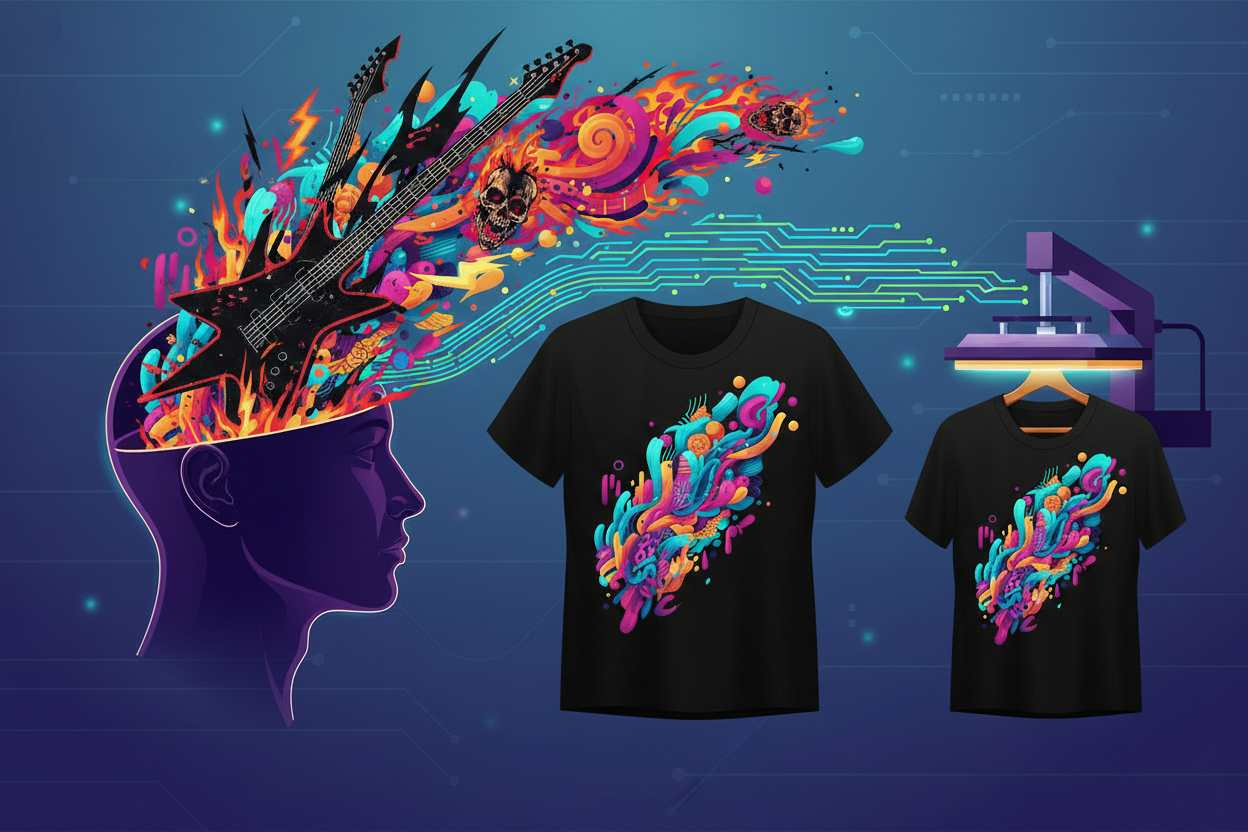
Close your eyes for a second. You're standing in front of your wardrobe. Everything in it is fine. Perfectly wearable. Does the job. But none of it is yours — not really. Not in the way that a t-shirt feels like yours when the design on it says something that no off-the-shelf product ever quite managed to say for you. You know the feeling. The gap between what exists and what you actually want.
So we're asking the question straight. If you could have anything on a t-shirt — absolutely anything — what would it look like? No limits, no licensing restrictions, no compromise. Just you, a blank tee, and the full run of your imagination. What comes out?
The best t-shirt you've ever owned probably found you. The best one you'll ever own might need to be built.
Start With The Feeling
Before you think about imagery, think about how you want the shirt to feel when you put it on. Not the fabric — the energy. Does it feel like a battle cry? A quiet flex? A piece of art that most people walking past won't fully understand but the right people will clock immediately? Is it aggressive, or is it beautiful, or is it somehow both at the same time?
The best t-shirts work like that. They carry a mood before you even read them properly. Think about the last time a stranger's shirt made you do a double-take — what was it that stopped you? Was it the image, the placement, the colour, the fact that it felt like it was made for exactly one type of person and that person happened to be standing in front of you? That reaction — that's what we're chasing. What's the version of that for you?
What Are You Actually Into?
Here's where it gets interesting. Most people, when pushed, don't actually want a t-shirt with a band name on it. They want a t-shirt that captures what that band means to them — the atmosphere of a specific album, the feeling of a particular gig, the era of their life that music soundtracked. That's a completely different brief.
So ask yourself: is it a specific gig you'll never forget? A lyric that's lived in your head for twenty years? An album cover that felt like it was made for you personally? A moment — first mosh pit, first festival, first time a song hit you so hard you had to sit down? The imagery that makes the best t-shirts isn't always the obvious stuff. Sometimes it's the reference that only makes sense to you and five other people. Those are always the best ones.
Think About The Visual Language
Forget the subject for a moment and think about the style. Are you drawn to the classic vintage band-tee aesthetic — oversized print, slightly washed-out, looks like it was made in 1987 and has been on tour ever since? Or is it something cleaner, more graphic, bolder lines and high contrast? Maybe it's illustrative — detailed, intricate artwork that rewards a closer look. Maybe it's typographic — the right words in the right font doing more work than any image could.
Think about placement too. Front and centre, chest height, commanding attention? A back print that hits people as you walk away? A left chest detail that's subtle enough to be almost a secret? Sleeve print? All of the above? The where is almost as important as the what. A great design in the wrong place is a wasted design.
- Vintage distressed print — worn, toured, lived-in before it's even left the shelf
- Bold graphic — high contrast, immediate impact, no explanation needed
- Detailed illustration — the kind of art that becomes a conversation starter
- Pure typography — the right words, the right font, nothing else required
- Abstract or symbolic — imagery that means something specific to you without spelling it out
A great t-shirt design doesn't just show what you're into. It shows how you think.
The Colours, The Fabric, The Whole Thing
Black tee, white print. It's the default for a reason — it works, always. But it's not the only answer. What if the garment colour is part of the design? Washed-out burgundy with a faded gold print that looks like it's been through a decade of summers. Slate grey with a stark white graphic that reads almost like a warning sign. Army green with something dark and detailed printed across the back that takes a few seconds to fully make out.
And the cut matters too. Oversized and boxy is having its moment for good reason — it changes how a print sits, how a shirt feels, how the whole thing moves when you're in a crowd. Or maybe you want something that fits properly, wears tight, feels like armour. The same design on two different silhouettes is a completely different shirt. What does yours look like when you're wearing it in the pit?
What If You Could Actually Have It Made?
Here's the bit where we stop being hypothetical. At Moshed, we're genuinely interested in what you want — not in a market-research, clipboard-and-lanyard way, but because the whole point of what we do is make clothing for people who care about music and culture as much as we do. And the people who care the most usually have the clearest vision of what they want to wear.
We work with designers who understand this world. People who know the difference between something that looks like rock clothing and something that is rock clothing. If you've got a concept — even a rough one, even just a feeling or a reference point — we want to hear it. Tell us what you're imagining. Tell us the mood, the era, the specific energy you're trying to capture. We'll take it from there.
It doesn't have to be fully formed. Some of the best briefs we've ever worked from have been a single sentence. "It should feel like standing at the back of a venue before the lights go down." That's enough. That's something to work with. Give us the feeling and we'll find the design that carries it.
You don't need to know exactly what you want. You just need to know how it should feel.
So Tell Us
We're asking for real. Drop it in the comments, send us a message, slide into the DMs with a voice note if that's easier — however you want to do it. Tell us what's been missing from your wardrobe. Tell us the t-shirt you've never been able to find because it hasn't existed yet. Tell us what you'd put on a blank shirt if the only limit was your own imagination.
We're listening. And if what you describe sounds like something that should exist in the world, there's a very good chance we can make it happen.
What's the design that's been living in your head? Let's get it on a shirt.