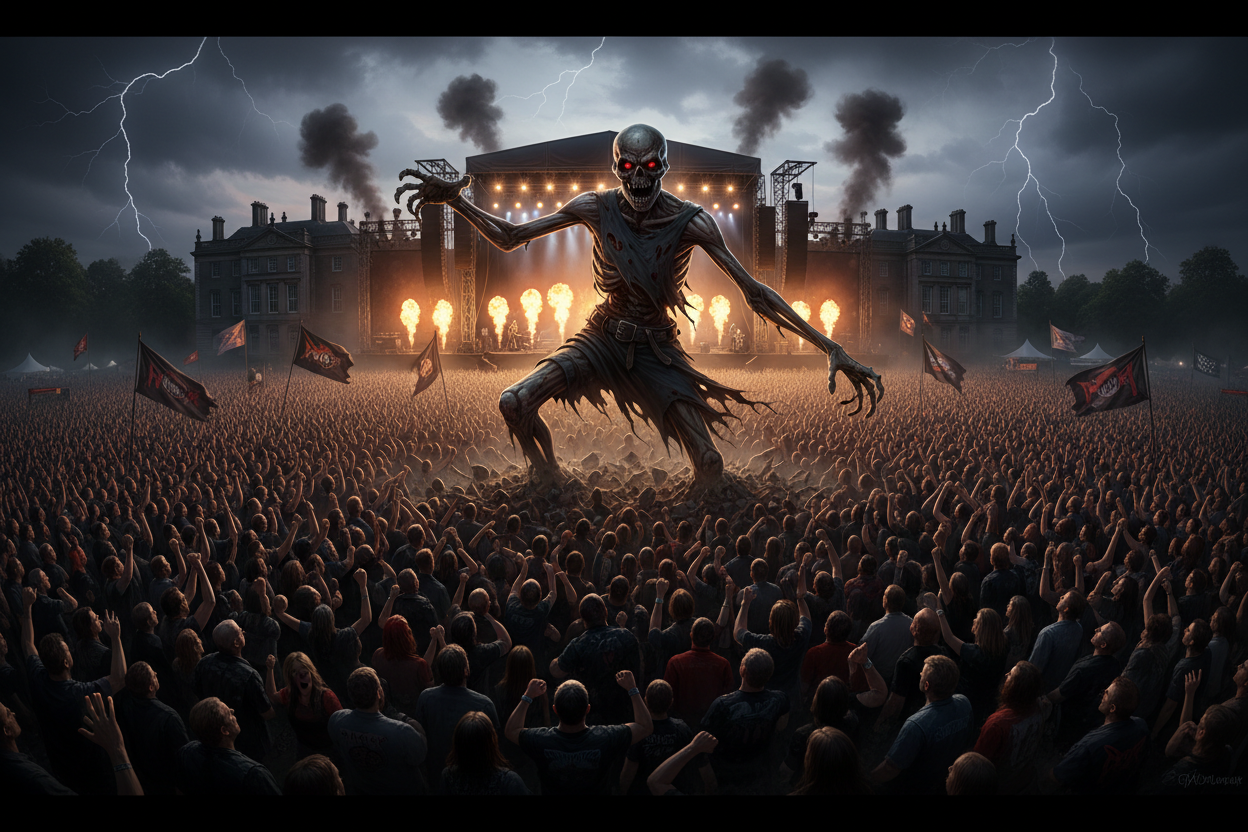
This weekend, a field in Hertfordshire becomes the most metal place on Earth. Iron Maiden are turning fifty, and instead of a stadium show with a merch stall bolted on, they've built an entire festival around the anniversary — Eddfest, two days at Knebworth Park on 10th and 11th July, with a walk-through museum of five decades of stage props, a second stage, a funfair, and more Eddie than any human being has a right to encounter in one weekend.
We're a t-shirt brand that owes an embarrassing amount to this band, so we're not pretending to be neutral about this. Iron Maiden basically invented the idea that a mascot could be the main character of a metal band's whole visual identity — and fifty years later, that idea is the reason half our own back catalogue exists. So let's talk about Eddie, the tours, and why a rotting corpse in a Union Jack has ended up on more chests than almost anything else in music.
Iron Maiden didn't just put a mascot on their merch. They built a universe, and let the merch be the door in.
WHO IS EDDIE, ACTUALLY
Eddie the Head first turned up in 1980 on the cover of Iron Maiden's self-titled debut — a snarling, sickly green ghoul glaring out from behind prison bars, painted by artist Derek Riggs. He wasn't meant to become the most consistent character in heavy metal. He was meant to sell one record. Riggs kept drawing him for cover after cover, and the band kept finding new ways to kill, resurrect, and reinvent him: a cyborg on Somewhere in Time, a puppeteer on Powerslave, a straitjacketed patient on Piece of Mind, an electric-chair casualty on Live After Death.
What made Eddie different from every other band logo of the era wasn't the gore — plenty of bands had gore. It was that he had continuity. He aged with the albums. He turned up in different eras, different costumes, different states of decomposition, and somehow always looked unmistakably like the same character. That's an unusually disciplined piece of world-building for a band that started out playing pubs in Leytonstone.
By the time The Number of the Beast hit in 1982, Eddie wasn't just cover art any more. He was walking on stage. He was in the tour programme. He was on the shirt you bought at the merch stand because you couldn't afford the album and the shirt too, so you got the shirt, because the shirt was the one you could wear to school on Monday.
EDDIE ON YOUR CHEST
This is the bit that matters to us. Iron Maiden shirts didn't behave like normal band merchandise. A lot of band tees are just a logo and a tour date — fine, functional, forgettable in six months. Eddie shirts became things people kept for decades, because each one was effectively a different piece of art depending on which era of the band you'd bought into. The Number of the Beast devil-puppet shirt says something different to the wearer than the Trooper shirt with Eddie charging out of the trenches on a WWI battlefield, which says something different again to the Powerslave pharaoh.
That's the trick that print-on-merch bands have been chasing ever since: give the fan a piece of art worth wearing, not just a name worth advertising. Iron Maiden worked this out decades before "wearable art" was a phrase anyone used un-ironically. Every album cycle was a new Eddie, which meant every album cycle was a new shirt worth queueing for. Five decades in, there are now dozens of distinct, collectible versions of the same character, and metal fans will happily argue for hours about which era's Eddie is the definitive one. Correct answer: whichever one was on the first shirt your mum reluctantly bought you.
FIFTY YEARS OF NOISE
Iron Maiden formed in 1975, built by bassist Steve Harris out of the pub-rock and NWOBHM scene bubbling up around London's East End. The classic run that most people think of when they hear the name — Bruce Dickinson on vocals, twin and eventually triple guitar harmonies, galloping bass lines you could set a metronome to — didn't fully click into place until Dickinson joined in 1981/82, but the foundations were already there: theatrical, literary, unafraid of a seven-minute song about a Coleridge poem.
A few points on the map, for anyone who needs reminding why this band gets talked about the way it does:
- 1982 — The Number of the Beast. The album that turned Maiden from a promising NWOBHM act into a genuine phenomenon, and the one that got them denounced from pulpits for the title track alone. Free publicity money can't buy.
- 1985 — Rock in Rio and Live After Death. The Powerslave tour's Egyptian stage set and the resulting live album became the template for how a metal band "does" a live show — pyramids, sarcophagi, Eddie towering over the drum riser.
- 1988 — Seventh Son of a Seventh Son. Proof the band could go full concept-album prog without losing an ounce of heaviness, and a top 5 UK chart entry to go with it.
- 1999 — Dickinson and guitarist Adrian Smith return. After a run of albums with singer Blaze Bayley, the classic line-up reformed, arguably saving the band from becoming a nostalgia act before they'd even hit their forties.
- 2000 — Brave New World. The reunion album that proved the comeback wasn't just for the greatest-hits tour — it could still write.
- 2010s onward — global stadium status. The Book of Souls world tour, Dickinson flying the band's own 747 (nicknamed Ed Force One) between shows, and a fanbase that spans generations who weren't alive for the first Eddie.
- 2025–26 — Run For Your Lives. The tour built around the 50th anniversary, culminating not in a normal closing gig but in Eddfest itself — a two-day takeover of Knebworth Park, a venue with its own pedigree of hosting era-defining shows.
Fifty years, sixteen-plus studio albums, one dedicated aircraft, and a mascot with more costume changes than most Vegas residencies. Not bad for a band that started out playing to whoever wandered into a Leytonstone pub on a Tuesday.
WHY EDDFEST MATTERS TO ANYONE WHO WEARS A BAND SHIRT
Eddfest isn't just a gig with a name. It's the band treating their own visual history as worth building a physical space around — the Infinite Dreams Museum walking fans past actual stage props and relics, Maidenville built around the Eddie's Dive Bar concept they've been running at shows for years, an entire funfair themed around a character who started life as green paint on a record sleeve in 1980. That's what happens when a mascot outlives the trend cycle: he stops being merchandise and starts being heritage.
It's also, frankly, the whole argument for why band tees are worth caring about in the first place. A shirt with the right art on it isn't a receipt for a gig you went to. It's a small, wearable piece of a bigger story — one era of one band's fifty-year fight to make heavy music feel like an event. Eddie's been dying and coming back on t-shirts since before most of Eddfest's ticket-holders were born, and people are still queuing up to put him on their chests.
Fifty years on, Eddie's still the best argument heavy metal has ever made for the humble t-shirt.
We won't be at Knebworth's merch stand this weekend, but the principle behind it is the same one we build every design around: a shirt should tell you something about the person wearing it before they've said a word. Iron Maiden worked that out in 1980 with a rotting corpse behind prison bars. We're just trying to keep the tradition going.