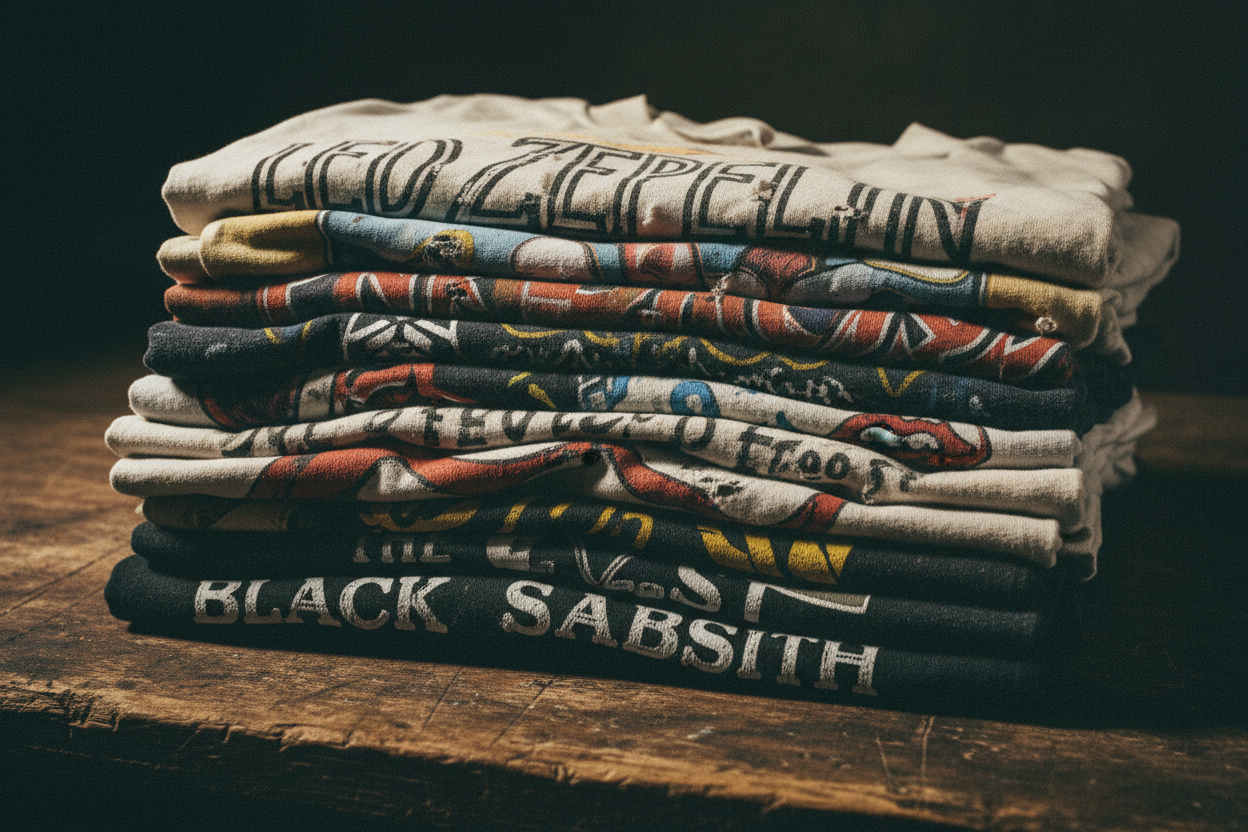
Before the algorithm. Before the drop. Before the screen-printing press, the merch table, the tour programme — there was a simple human impulse that has never once changed in the seventy-odd years since rock music announced itself to a bewildered world. People wanted a piece of it. A physical, holdable, wearable fragment of something that made them feel alive. That impulse is the entire history of rock merch. Everything else is the story of how we got better at supplying it.
It is one of the most extraordinary commercial stories of the twentieth century — an industry built almost entirely on emotion. On the feeling in your chest when the first chord rings out. Nobody needs a T-shirt. But everyone wants one, because wanting it is really just another way of saying: this music matters to me and I want the world to know it.
So. Let's go back. All the way back.
The 1950s — The Earliest Days
The prehistory of rock merch starts not with T-shirts but with paper. Tour programmes. Fan club newsletters. Photographs sold at the stage door. In the early days of rock and roll — when Elvis Presley was causing actual moral panic on American television — the most sophisticated piece of fan merchandise available was a black and white photo that cost a few cents and came slightly bent in the post.
The T-shirt was not yet a cultural object. It was underwear. Literally — worn under things, invisible, utilitarian. The idea that you would print something on it and wear it as a statement had not yet occurred to anyone with a printing press. When it did occur to someone, it changed everything.
What existed instead were novelty items — pins, badges, pennants. The infrastructure was chaotic. The money was inconsistent. The artists were frequently being exploited in ways that make your eyes water with hindsight. But the fans? The fans were already there, pressing against barriers, screaming until their throats gave out, desperate for anything tangible they could take home.
Rock music arrived like a thunderclap in a library. Nobody had infrastructure for it. They were making it up as they went — including the merch.
The 1960s — When the Tee Became the Thing
The moment that arguably ignited the modern rock merch industry wasn't a rock concert — it was Beatlemania. When The Beatles landed in America in February 1964, the commercial machine that scrambled to capitalise on it invented modern pop merchandise almost by accident.
Beatles wigs. Beatles lunchboxes. Beatles wallpaper. The licensing was chaotic and largely out of the band's control, but the principle was established: a fan's desire to own something connected to the music they loved was essentially bottomless, and someone was going to meet that desire.
By the late 1960s, the T-shirt had begun its transformation from underwear to statement. Grateful Dead concerts were among the first rock events where merchandise became a fixture outside the venue. Bootleggers followed immediately, selling unofficial product from van boots in car parks — establishing a grey economy that would shadow the official merch industry for the next five decades and still does.
The 1970s & 80s — The Golden Age
If you want to understand rock merchandise in your bones, you need to understand the 1970s and 1980s. This is the period that created the visual language of rock, established the merch table as a sacred institution, and produced the designs people are still ripping off and paying enormous sums for on eBay today.
The 1970s gave us stadium rock and stadium rock gave us the merch table at scale. When Led Zeppelin sold out Madison Square Garden, when Black Sabbath toured America to crowds of tens of thousands — the demand for physical souvenirs was enormous and the industry professionalised to meet it. The concert tee evolved from a simple logo into a full canvas — wraparound prints, intricate illustrations, tour dates down the back, visual ambition that turned a piece of clothing into a piece of art.
The 1980s took everything the 1970s had built and plugged it into a Marshall stack. Heavy metal and hard rock became the dominant commercial forces in rock, and their visual identity — skulls, flames, gothic typography, landscapes that suggested the apocalypse was imminent and extremely loud — translated perfectly onto merchandise. Iron Maiden's Eddie became one of the most recognised characters in popular culture. Metallica's Pushead-illustrated merch transcended the fanbase entirely. Motörhead's Warpig logo became genuinely iconic.
The 1980s metal tee wasn't merchandise. It was a declaration of war against every beige, sensible thing the mainstream stood for.
The relationship between fan and band was encoded in the merch table in a way it wasn't anywhere else. Buying a shirt was a transaction, yes — but also a handshake. An agreement. A declaration of belonging. The kid who saved up their paper round money to buy a Maiden shirt outside Hammersmith Odeon in 1982 wasn't just buying cotton. They were buying membership of something that mattered enormously to them.
The 1990s — Grunge and the Credibility Question
The 1990s introduced a complication the rock merch world has never entirely resolved: the question of credibility. When grunge arrived from Seattle with its thrift-store aesthetic and studied anti-commercialism, the merch table found itself in an awkward philosophical position.
Could a band that stood for anti-consumerism sell T-shirts without betraying everything they stood for? Nirvana navigated this with characteristic complexity — Kurt Cobain was deeply uncomfortable with the commercial apparatus surrounding the band's success, and yet Nirvana merchandise existed, sold, and is now worth a fortune. The tension between rock's anti-establishment identity and its enormous commercial reality was never more visible than in the 1990s.
What the decade also gave us was the rise of independent labels, zine culture, and DIY merchandise — bands running their own mail-order operations, printing shirts in bedrooms. That underground economy, running parallel to the major-label world, kept something raw and direct alive in rock merch. That spirit never died. You're reading a blog built on it right now.
The 2000s & 2010s — The Internet Changes Everything
The internet did to the rock merch industry exactly what it did to everything else: it democratised access, destroyed margins, created new opportunities, and made everything simultaneously easier and harder. Bands could sell directly to fans worldwide from a basic website. Print-on-demand services emerged. The bootlegger moved online.
But the internet also did something subtler and more interesting: it created a culture of vintage. The 1980s concert tees that people had worn to rags and kept in loft boxes suddenly had value nobody anticipated. A tour shirt from the 1984 Black Sabbath 'Born Again' tour — bought for a fiver outside the NEC — became worth hundreds. The rock T-shirt had become an artefact. A historical object with genuine cultural and monetary worth.
Meanwhile, the festival boom of the 2000s and 2010s created a new merch landscape. Download, Glastonbury, Reading, Leeds — these events weren't just concerts, they were cultural gatherings where the merch transaction meant something different. The festival T-shirt as proof of attendance. As shared experience. As the thing you show someone three years later and you both remember exactly where you were standing when the headline act took the stage.
The 2020s — AI Enters the Chat
And so we arrive at the present moment, which is genuinely one of the most interesting inflection points in the history of rock merchandise since the screen printing press made elaborate designs commercially viable in the 1970s. Artificial intelligence image generation has entered the creative process — and the rock world, predictably, has opinions about it.
The concern that AI-generated design undermines human creativity is not a stupid concern. It comes from artists who have spent years developing skills and a visual language, who look at AI output and feel that something is being cheapened. That feeling deserves respect.
But here is the counter-argument, and we'd suggest it's the stronger one: the history of rock visual art has always been the history of tools being pushed beyond their intended purpose. Airbrush technology gave us the fantasy art covering 1970s prog rock sleeves. Xerox machines gave us the DIY punk aesthetic. Desktop publishing gave every indie label in the 1990s access to professional design capabilities. Each time, the same argument was made: this isn't real art. Each time, extraordinary things were made anyway.
AI is not the end of rock art. It is the next pedal on the board. The player still has to know how to use it. The song still has to mean something.
What AI image generation actually does, at its most useful, is collapse the distance between imagination and realisation. The person who has always had enormous visual ideas but not the technical training to execute them can now build a feedback loop between their instincts and a tool that responds to them. The result requires taste, judgment, iterative refinement, and a clear sense of what you're trying to achieve. But the barrier to entry has fallen, and what comes through that door first will be the people with the most passion and the most original ideas.
For rock merchandise specifically, this matters enormously. The visual language of rock — the darkness, the texture, the sense that something enormous and slightly dangerous is happening — is perfectly suited to AI generation when it's steered by someone who actually understands that language.
That is exactly what we're doing at Moshed. Not replacing creativity — amplifying it. Using AI the same way every generation of rock designers used whatever tool was in their hands: with intent, with taste, and with an absolute refusal to produce anything that doesn't feel like it belongs at the front of the pit.
The Unbroken Thread
From that first blurry black-and-white photograph sold at the stage door in 1956 to the AI-assisted designs dropping on moshed.co.uk in 2026, the fundamental thing has not changed. Rock merchandise exists because music creates a hunger for the physical. Because something that moves you that deeply deserves a material expression.
The tools change. The scale changes. The formats evolve and the industry mutates and the technology advances. But the person standing at a merch table, holding a shirt up to the light, deciding whether this is the one — that person is exactly the same as they were seventy years ago. Still chasing that feeling. Still wanting a piece of something extraordinary.
We're just here to make sure the piece is worth having.